Revisiting the Uniform Information Density Hypothesis in LLM Reasoning
1Yonsei University · 2OneLine AI
mjgwak@yonsei.ac.kr, jaehyungk@yonsei.ac.kr
Abstract
The Uniform Information Density (UID) hypothesis proposes that effective communication is achieved by maintaining a stable flow of information. In this work, we revisit this principle in the context of Large Language Model (LLM) reasoning, asking whether step-level uniformity reflects reasoning quality. To this end, we introduce a novel framework to quantify uniformity of information flow at both local and global levels, using an entropy-based stepwise density metric. Across experiments on seven reasoning benchmarks, we see a counter-intuitive pattern: high-quality reasoning exhibits smooth step-by-step transitions (local uniformity) and structured, non-uniform information flow at the trajectory level (global non-uniformity). The results demonstrate that these uniformities outperform alternative internal signals as predictors of reasoning quality, and such divergence with human communication is not a model deficiency, but a byproduct of distinct objectives between human communication and LLM reasoning.
Key finding. Successful LLM reasoning aligns with high local uniformity and low global uniformity in stepwise entropy—differing from human UID, yet useful for Best-of-N selection and failure prediction.
Reasoning as information flow
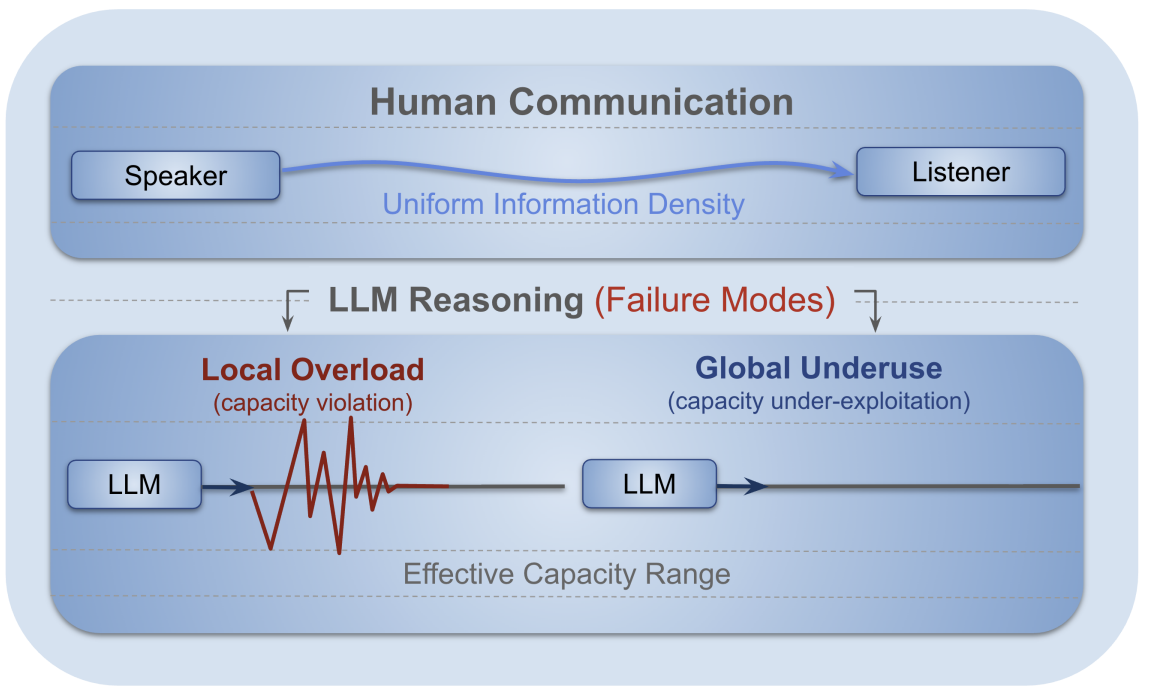
Reasoning as information flow. Human communication distributes information smoothly to respect channel capacity, enabling successful understanding.
LLM reasoning transmits information across reasoning steps; failures arise from local overload (sharp spikes) and underuse (flat trivial trajectory).
Contributions
- We revisit the Uniform Information Density hypothesis in the setting of chain-of-thought LLM reasoning.
- We find that global non-uniformity together with local uniformity in surprisal correlates with reasoning success on challenging math benchmarks.
- We show that deviations from these patterns act as trace-level signals for predicting failures, complementing response-level aggregation and evaluation.
Citation
@inproceedings{gwak-etal-2026-revisiting,
                title = "Revisiting the {U}niform {I}nformation {D}ensity Hypothesis in {LLM} Reasoning",
                author = "Gwak, Minju  and
                  Son, Guijin  and
                  Kim, Jaehyung",
                editor = "Liakata, Maria  and
                  Moreira, Viviane P.  and
                  Zhang, Jiajun  and
                  Jurgens, David",
                booktitle = "Findings of the {A}ssociation for {C}omputational {L}inguistics: {ACL} 2026",
                month = jul,
                year = "2026",
                address = "San Diego, California, United States",
                publisher = "Association for Computational Linguistics",
                url = "https://aclanthology.org/2026.findings-acl.1565/",
                pages = "31304--31333",
                ISBN = "979-8-89176-395-1",
                abstract = "The Uniform Information Density (UID) hypothesis proposes that effective communication is achieved by maintaining a stable flow of information. In this work, we revisit this principle in the context of Large Language Model (LLM) reasoning, asking whether step-level uniformity reflects reasoning quality. To this end, we introduce a novel framework to quantify uniformity of information flow at both local and global levels, using an entropy-based stepwise density metric. Across experiments on seven reasoning benchmarks, we see a counter-intuitive pattern: while high-quality reasoning exhibit smooth step-by-step transitions (local uniformity) and structured, non-uniform information flow at the trajectory level (global non-uniformity). The results demonstrate that these uniformities outperform alternative internal signals as predictors of reasoning quality, and such divergence with human communication is not a model deficiency, but a byproduct of distinct objectives between human communication and LLM reasoning."
            }
}